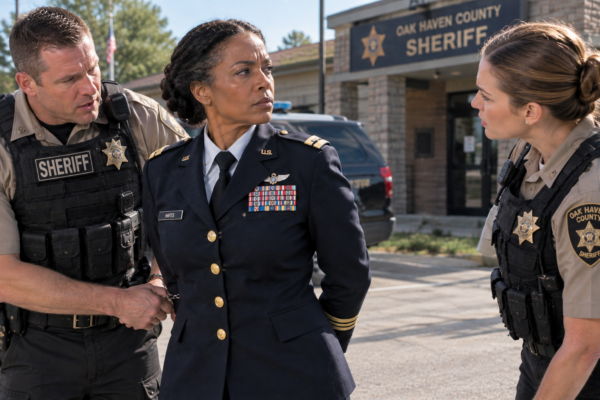
**THEY HANDCUFFED A BLACK FOUR-STAR GENERAL DURING HIS MORNING RUN—BY SUNRISE THE PENTAGON WAS CALLING**
**CHAPTER 1 — THE MAN IN THE BACK OF THE CRUISER**
Cops arrested a Black four-star general and had no clue who they were putting in handcuffs.
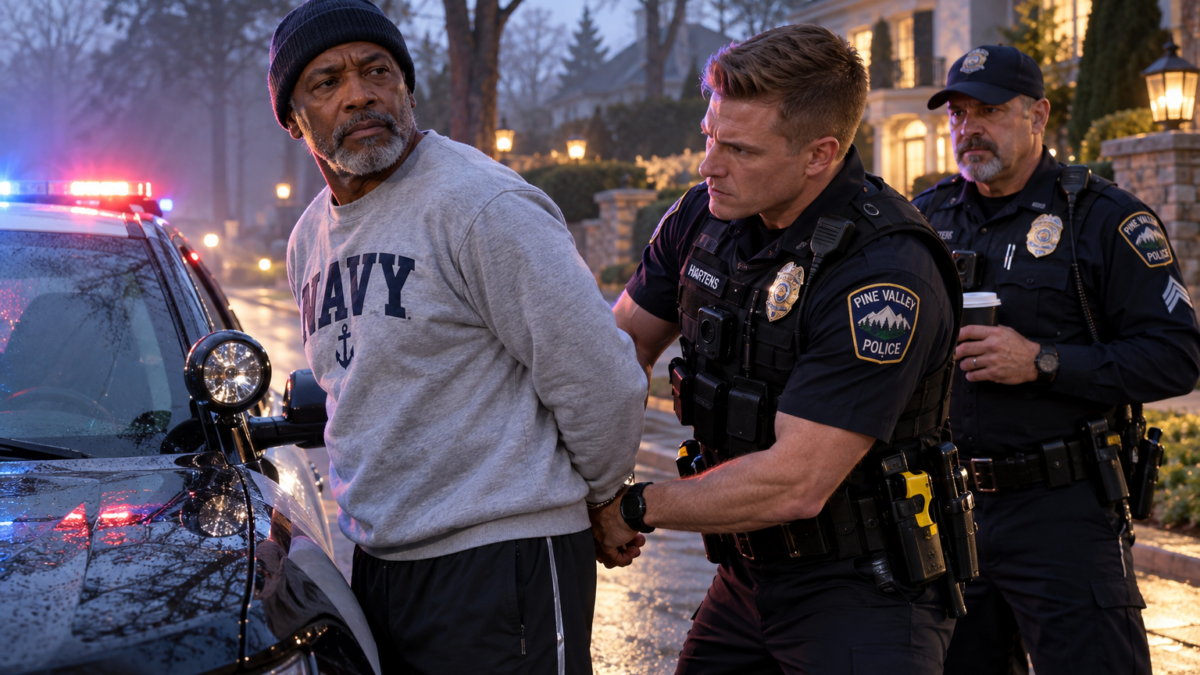
They spotted an older Black man jogging along one of the wealthiest streets in Pine Valley and decided he matched the image of a suspect.
Ten minutes later, he was sitting handcuffed in the back of a patrol cruiser while the officers joked about prowlers, completely unaware they had just detained one of the highest-ranking military commanders in the United States.
By sunrise, their police chief would be taking calls from the Pentagon.
General Isaiah Montgomery had survived combat zones, classified briefings, ambushes, congressional hearings, and rooms packed with men who believed speaking louder somehow counted as strategy.
At fifty-eight, he carried thirty-five years of Army discipline in the way he stood, moved, breathed, and listened.
Four stars.
Two Purple Hearts.
A Silver Star.
Deputy commander of a joint forces command whose real missions most Americans would probably never read about, even decades later.
But on that Tuesday morning, none of those things could be seen.
No dress uniform.
No ribbons.
No aides.
No security detail.
He wore only a faded gray Navy sweatshirt that an admiral friend had once given him as a joke, black running pants, worn athletic shoes, and a beanie pulled low against the cold Virginia air.
He was in Pine Valley for one reason.
His daughter, Captain Leah Montgomery, was returning home from Walter Reed that afternoon.
She had lost part of her right leg overseas while dragging wounded Marines away from a burning transport after an ambush.
Isaiah had bought a quiet one-story house on Willow Creek Lane because it had wide hallways, level floors, and enough natural light for the woman who had once told him that hospital rooms made her feel as though she was being stored rather than healed.
He had gone out for a six-mile run to clear his mind before she arrived.
Morning fog drifted low across carefully maintained lawns.
Sprinklers clicked quietly.
Expensive homes stood behind stone walls and perfectly trimmed hedges.
Isaiah was about half a mile from the house when he noticed the patrol cruiser following his pace.
He noticed it before the emergency lights ever came on.
Men who have commanded troops in hostile territory do not overlook vehicles that slow down behind them.
The siren gave a single short chirp.
Isaiah immediately stopped, stepped onto the grass, and kept both hands where the officers could clearly see them.
The cruiser pulled sharply toward the curb.
Officer Blake Higgins stepped out first.
Young.
Rigid.
One hand already hovering close to his weapon.
Sergeant Mitchell Carter emerged more slowly.
Older.
Coffee cup in hand.
Wearing the tired expression of a man who had stopped asking younger officers the questions they needed to hear.
“Where are you going?”
Higgins demanded.
Isaiah met his stare calmly.
“Good morning, Officer. I’m finishing my run. My house is on Willow Creek.”
“Your house?”
Carter repeated, almost laughing.
“Yes.”
“We’ve had burglaries around here,” Higgins said sharply. “Let me see some ID.”
“I don’t carry my wallet when I run. You’re welcome to escort me to 442 Willow Creek Lane, and I’ll provide identification there.”
Higgins moved closer.
“That’s not how this works.”
Isaiah glanced once toward the officer’s hand before returning his gaze to Higgins’s face.
“I strongly suggest you contact your watch commander before you escalate this stop.”
It was exactly the wrong thing to say to a man who mistook advice for disrespect.
Higgins’s face reddened.
“Turn around and place your hands on the hood.”
Carter remained silent.
That became his first serious mistake.
Isaiah could have argued.
He could have stated his rank.
He could have demanded that a supervisor come to the scene.
But he had witnessed too many roadside encounters become deadly because one armed man valued obedience more than the truth.
So the general turned around.
He placed both hands on the hood.
He allowed the younger officer to search him as though he were a criminal.
The only item Higgins discovered was a house key.
Even so, he pulled out the handcuffs.
Cold steel closed around Isaiah Montgomery’s wrists.
Too tight.
Unnecessarily tight.
“You are making a mistake,” Isaiah said in a low voice.
Higgins pushed him toward the patrol car.
“Tell it to the judge.”
Carter opened the back door and guided him into the rear seat.
The door slammed shut.
Isaiah sat straight in the metal cage, wrists aching, eyes calm and focused.
He was not frightened.
He was memorizing everything.
Badge numbers.
Names.
Times.
Tone of voice.
Every sentence.
Every detail.
Because these officers believed they had captured a prowler.
What they had actually done was create a problem that would move far beyond Pine Valley.
—
The original call had come in at 6:11 that morning.
A woman on Hawthorne Crest reported someone walking behind her neighbor’s hedges.
Male.
Dark clothing.
Possible burglary suspect.
No weapon seen.
No entry observed.
No clear face.
Dispatch entered the description:
**MALE, APPROXIMATELY 20–35, MEDIUM BUILD, DARK HOODIE, POSSIBLY CARRYING BACKPACK.**
Isaiah was fifty-eight.
Broad-shouldered.
Gray sweatshirt.
No backpack.
Running openly on the sidewalk nearly a mile from Hawthorne Crest.
Those differences should have mattered.
They did not.
—
Higgins closed the rear door.
Then looked at Carter.
“Told you.”
Carter sipped his coffee.
“Told me what?”
“Something was off.”
Inside the cruiser, Isaiah heard everything through the partially open front window.
Carter glanced back.
“He doesn’t really fit the age.”
Higgins shrugged.
“People lie about age in calls.”
“Call didn’t give his age. Dispatcher did.”
“Whatever.”
Isaiah stored that sentence too.
—
Carter walked toward the sidewalk and looked down.
Running shoe tracks.
Nothing else.
No pry tool.
No gloves.
No backpack.
No property.
No reason to believe the man in the cruiser had come from the house originally reported.
He knew it.
Isaiah saw it in his face when Carter returned.
But Carter did not stop the detention.
That became his second serious mistake.
—
Higgins opened the driver’s door.
“We’ll take him in and sort it out.”
Carter frowned.
“For what?”
“Suspicious person.”
“That’s not a charge.”
“Failure to identify.”
“He said his name.”
Isaiah had.
Twice.
**Isaiah Montgomery.**
Higgins had not written it down.
—
“He doesn’t have ID.”
Carter rubbed his jaw.
“Not carrying ID while jogging isn’t automatically an offense.”
Higgins stared at him.
“So now you’re defending him?”
Carter looked toward Isaiah.
Then away.
“No.”
One word.
Cowardice rarely announces itself with a speech.
Sometimes it sounds like that.
—
The cruiser pulled away at 6:24.
Isaiah watched Pine Valley move past the rain-streaked window.
Willow Creek Lane appeared on the right.
His house sat less than four hundred yards away.
Lights on.
A wheelchair ramp completed two days earlier.
His military aide, Colonel **Rebecca Sloan**, was supposed to arrive at seven with several secure briefing folders Isaiah planned to review before Leah’s transport reached the house.
His phone was inside the kitchen charging.
His wallet sat beside it.
His Pentagon credential case lay on the entry table.
Everything Higgins had demanded was less than a minute away.
—
Isaiah leaned forward as far as the cuffs allowed.
“My residence is on the next street.”
Higgins looked at him in the mirror.
“Sit back.”
“You can verify my identity there in under two minutes.”
“Sit back.”
“Officer—”
Higgins slammed the divider with one palm.
“I said sit back.”
Isaiah did.
Then he looked toward Carter.
The sergeant stared out his window.
—
At 6:31, Colonel Rebecca Sloan drove into 442 Willow Creek Lane.
The garage door was open.
The house was unlocked.
Isaiah was gone.
That alone did not alarm her.
He ran frequently.
Then she saw the kitchen clock.
He had told her he would be back by 6:15.
Isaiah Montgomery did not casually miss agreed times during an active command week.
Rebecca called him.
His phone rang on the kitchen counter.
She frowned.
—
Then she saw the secure briefing pouch she was carrying.
The general was scheduled for an encrypted call at 7:00 with the joint operations center.
His absence now mattered.
Not because the country would collapse without him for forty-five minutes.
It would not.
But unexplained loss of contact with a four-star commander triggered verification procedures.
Rebecca called his executive officer.
Then his protective-security liaison.
Then local hospitals.
No accident report.
No emergency admission.
At 6:39, she contacted the Pine Valley Police Department.
—
The desk officer answered.
“Pine Valley Police.”
“This is Colonel Rebecca Sloan. I’m attempting to locate General Isaiah Montgomery.”
The desk officer paused.
“Military general?”
“Yes.”
“He missing?”
“I am asking whether your officers have had contact with him.”
“Description?”
“Black male, fifty-eight, six foot two, approximately two hundred pounds, gray Navy sweatshirt, black running pants, black knit cap.”
Silence.
The desk officer looked toward the holding area.
Then at the patrol log.
One entry.
**UNKNOWN B/M DETAINED — POSSIBLE BURGLARY SUSPECT.**
His stomach dropped.
—
“What’s his name again?”
Rebecca heard the change immediately.
“General Isaiah Montgomery.”
“Ma’am, hold please.”
“No.”
The desk officer froze.
“Excuse me?”
“Do not place me on hold.”
Her voice remained calm.
“Tell me whether your officers have a man matching that description in custody.”
—
Across the station, Higgins was laughing with another officer.
Isaiah sat handcuffed to a bench.
Carter filled out an incident sheet.
No one had formally booked him.
No probable cause statement existed.
No charge had been decided.
They had simply brought him in.
—
The desk officer stood.
“Sergeant Carter?”
Carter looked up.
“What?”
“Guy you brought in.”
“What about him?”
“What did he say his name was?”
Carter stared at the paperwork.
The name box was empty.
—
Isaiah answered from the bench.
“I told both officers.”
Everyone turned.
“Isaiah Montgomery.”
The desk officer slowly lowered the phone from his ear.
—
Colonel Sloan could still be heard.
“Hello?”
The officer lifted it again.
“Yes, ma’am.”
“Is he there?”
The officer looked at Isaiah.
Then at the four silver stars that were not visible because Isaiah was wearing a sweatshirt.
“Yes.”
—
Rebecca closed her eyes.
“Is he free to leave?”
The officer did not answer.
That answer was enough.
—
“I need your watch commander.”
—
Lieutenant **Daniel Price** came from the back office carrying half a breakfast sandwich.
The desk officer whispered three sentences.
Price stopped chewing.
He walked directly toward Isaiah.
“Sir.”
Isaiah looked up.
“What is your full name?”
“Isaiah James Montgomery.”
“Date of birth?”
Isaiah gave it.
“Address?”
“442 Willow Creek Lane.”
Price looked toward Carter.
“That’s the street you stopped him near.”
Carter nodded slowly.
—
Price asked:
“Sir, are you active-duty military?”
“Yes.”
“Rank?”
Isaiah held his gaze.
“General.”
Higgins laughed from the report desk.
“Come on.”
Nobody else did.
—
Price ignored him.
“Branch?”
“United States Army.”
“Assignment?”
Isaiah gave the unclassified title of his joint command position.
Price’s expression changed.
Higgins finally stopped smiling.
—
Price walked to the computer.
Opened a law-enforcement verification channel.
Then called the number Colonel Sloan provided independently through the Pentagon switchboard rather than simply trusting the incoming call.
That mattered.
Verification should run both directions.
—
The Pentagon duty desk confirmed enough.
Not classified details.
Not a biography.
Just:
**GENERAL ISAIAH J. MONTGOMERY — ACTIVE DUTY — IDENTITY VERIFIED.**
Price stared at the monitor.
Then at the handcuffs.
—
“Take those off.”
Higgins stood.
“Lieutenant, we haven’t cleared him on the burglary.”
Price looked at him.
“What evidence ties him to a burglary?”
“He matched.”
“No, he didn’t.”
“Close enough.”
Price’s face hardened.
“Take the cuffs off.”
—
Isaiah spoke first.
“Before you do, document the time.”
The room went silent.
Price looked at him.
“Sir?”
“Document when the restraints were applied, when I arrived here, and when they are removed.”
Higgins scoffed.
“Now he’s giving orders.”
Price snapped:
“Officer Higgins.”
That ended it.
—
A station camera photographed the cuffs.
Red impressions circled Isaiah’s wrists.
One area had begun swelling near his left thumb.
Time:
6:51.
The cuffs came off.
—
Isaiah rubbed his hands.
Then asked:
“Why was I stopped?”
Higgins answered.
“Burglary call.”
“What was the suspect description?”
Higgins hesitated.
Price looked at dispatch.
The dispatcher read it aloud.
“Male, twenty to thirty-five, medium build, dark hoodie, backpack.”
Everyone looked at Isaiah.
Fifty-eight.
Broad.
Gray sweatshirt.
No bag.
—
Isaiah asked quietly:
“Which part matched?”
No one answered.
—
Then the station telephone began ringing again.
Not one line.
Three.
Colonel Sloan.
Army liaison.
City manager’s office, after hearing a senior military officer had been detained.
—
Price looked toward Isaiah.
“General, I apologize.”
Isaiah’s expression did not change.
“For what?”
Price stopped.
That was not the reaction he expected.
—
“For the detention.”
“You were not present during the roadside contact.”
“No, sir.”
“Then don’t apologize for facts you have not reviewed.”
Price blinked.
—
Isaiah continued.
“Preserve the dispatch recording.”
Nothing.
“Patrol-car video.”
Nothing.
“Body cameras.”
Nothing.
“Station surveillance.”
Nothing.
“And every report draft.”
—
Higgins stepped forward.
“You’re threatening us.”
Isaiah looked at him.
“No.”
Nothing.
“I am making sure nobody has to rely on my memory alone.”
—
That sentence reached Sergeant Carter harder than anything else had.
Because Carter suddenly remembered his own body camera.
Still running.
—
Lieutenant Price turned.
“Both cameras active?”
Carter touched his chest.
“Yes.”
Higgins looked at his.
Then his face changed.
“My battery died.”
Price stared.
“When?”
“During the stop.”
—
Carter looked at him.
“No, it didn’t.”
The room became silent.
Higgins turned.
“What?”
Carter swallowed.
“Your camera was on when we left roll call.”
“So?”
“You checked it in the car.”
Higgins’s jaw tightened.
—
Price asked:
“Are you saying he intentionally turned it off?”
Carter looked at Isaiah.
Then at Higgins.
Then back at Price.
“I’m saying the battery wasn’t dead.”
—
Higgins stepped toward him.
“You better be careful.”
Isaiah watched Carter’s face.
Fear.
Not of violence.
Of choosing a side.
—
Then Carter did something he should have done forty minutes earlier.
He spoke clearly.
“He turned it off after we saw the runner.”
Higgins stared.
—
Price immediately ordered both body cameras and cruiser systems preserved.
No one touched them until a supervisor from Professional Standards arrived.
—
Isaiah stood.
“My daughter comes home from Walter Reed this afternoon.”
Nobody spoke.
“I am leaving.”
Price nodded.
“Of course.”
—
Higgins laughed bitterly.
“Must be nice.”
Isaiah stopped.
“What?”
“Being important enough that one phone call fixes everything.”
—
Isaiah turned slowly.
The anger everyone expected finally appeared.
Not loud.
Not wild.
Controlled.
—
“You think the problem is that you detained a general.”
Higgins said nothing.
“The problem is that you did not know I was one.”
Nothing.
“And you behaved as though not knowing who I was made it acceptable to stop asking questions.”
—
Higgins looked away.
—
Isaiah continued:
“My rank got the telephone answered quickly.”
Nothing.
“It did not create my right to be treated lawfully.”
—
Then he left.
—
At 7:42, he reached Willow Creek Lane.
Colonel Sloan stood on the porch.
She looked at his wrists.
Then his chin.
Then his face.
“What happened?”
Isaiah opened the front door.
“Later.”
—
Inside, the house had been prepared for Leah.
Wheelchair beside the hallway.
Fresh flowers on the kitchen table.
A ramp leading to the back patio.
Photographs from her childhood on the mantel.
Isaiah stopped in the center of the living room.
The morning finally reached him.
He sat down.
For several minutes, the four-star general said nothing.
—
Rebecca placed coffee beside him.
“They’re already calling from the building.”
“Who?”
“Chief of staff’s office. Army counsel. Pentagon security.”
Isaiah closed his eyes.
“Tell them no one is to pressure the local department.”
Rebecca looked surprised.
“Sir?”
“I want evidence preserved.”
Nothing.
“I want an independent review.”
Nothing.
“I do not want somebody in Washington frightening a small police department into telling me what they think I want to hear.”
—
Rebecca nodded.
Then looked at his wrists again.
“You’re angry.”
“Yes.”
“Good.”
He looked up.
“Why?”
“Because for a minute I thought you were going to pretend you weren’t.”
—
That almost made him smile.
Almost.
—
At 1:18 PM, a medical transport stopped outside.
Leah Montgomery came home.
She descended slowly using forearm crutches, her right trouser leg pinned neatly below the knee.
Isaiah stood in the doorway.
Everything from that morning disappeared.
For a moment.
—
“Dad.”
He crossed the lawn.
She hugged him.
Hard.
Then pulled back.
Saw his wrists.
“What happened?”
“Nothing you need today.”
Leah stared.
“Dad.”
He sighed.
—
She had inherited the voice.
—
Later, after dinner, he told her.
Not every detail.
Enough.
Leah listened.
Then asked:
“Did you tell them who you were?”
“No.”
“Why?”
“I gave them my name.”
“That is not what I asked.”
—
Isaiah looked at her.
She continued:
“You could have said four-star general.”
“Yes.”
“Why didn’t you?”
He thought.
Then answered:
“Because I wanted them to verify the person standing in front of them.”
—
Leah’s expression hardened.
“And if you’d been a plumber?”
Isaiah looked down at his wrists.
“That is exactly the question.”
—
At 5:40 the next morning, Police Chief **Richard Hale** arrived at headquarters.
Three federal liaison calls were waiting.
So were two city attorneys.
The mayor.
The department insurer.
And a preliminary report from Professional Standards.
—
Hale read the first page.
Then the second.
Then called Lieutenant Price.
“Where is Higgins?”
“Administrative leave.”
“Carter?”
“Working desk assignment pending interview.”
—
Hale turned the page.
Body-camera metadata.
Dispatch.
Cruiser audio.
Then one sentence from Carter’s recording.
Higgins’s voice:
**“Rich Black guy jogging before sunrise? Bet he’s checking houses.”**
Hale stopped.
Read it again.
—
Another line.
Carter:
**“He’s too old for the description.”**
Higgins:
**“Close enough.”**
—
The chief sat back.
The Pentagon calls suddenly became the least important thing on his desk.
Because General Isaiah Montgomery’s detention had not begun with a confusing identification problem.
It had begun before anyone asked his name.
# **END OF CHAPTER 1**
**CHAPTER 2 — THE WORDS NOBODY EXPECTED THE CAMERA TO KEEP**
The first person General Isaiah Montgomery asked about was not Blake Higgins.
It was Sergeant Mitchell Carter.
That surprised everyone.
Chief Hale called Isaiah the next morning.
“General, I want you to know Officer Higgins has been placed on administrative leave.”
Isaiah stood in his kitchen watching Leah practice transferring from crutches to her new wheelchair.
“That is your department’s decision.”
“Yes, sir.”
“And Sergeant Carter?”
“Temporary administrative assignment.”
“Why?”
Hale hesitated.
“Pending review.”
—
Isaiah looked through the window.
“Good.”
Hale sounded confused.
“You think he should be investigated?”
“I think standing beside misconduct does not become neutral merely because your hands are not the ones applying the cuffs.”
—
Silence.
—
Chief Hale did not argue.
Because he had watched the video.
Carter had questioned the age discrepancy.
Questioned the lack of ID offense.
Questioned taking Isaiah to the station.
Every time—
he stopped one sentence before intervention.
—
He knew enough to recognize danger.
Not enough to risk conflict with a younger officer he supervised.
That contradiction mattered.
—
The department requested an outside review from the county Inspector General’s law-enforcement division.
The city attorney supported it.
Army officials were informed but did not control it.
Isaiah gave a recorded statement.
Then stepped back.
He refused television interviews.
Refused morning shows.
Refused invitations to Congress to discuss the incident before the local evidence review was complete.
—
Leah thought he was being stubborn.
“You know everybody is already talking about it.”
“I know.”
“Then why let strangers define what happened?”
“Because I know what happened to me.”
Nothing.
“I don’t yet know what happened before me.”
—
That changed three days later.
—
Inspector **Naomi Brooks** requested all complaints involving Blake Higgins during his six years with Pine Valley.
There were nineteen.
That number meant almost nothing by itself.
Complaints are allegations.
Some justified.
Some mistaken.
Some impossible to resolve.
—
Brooks reviewed each independently.
Five involved rude language.
Three involved traffic citations supported by video.
Two involved lawful searches.
Those were closed without further concern.
Then came the rest.
—
A delivery driver named **Marcus Bell**.
Black.
Thirty-four.
Stopped inside Pine Valley after a homeowner reported “an unfamiliar van.”
Bell wore a company uniform.
Vehicle had commercial markings.
He showed an electronic delivery schedule.
Higgins detained him for forty-three minutes while verifying whether the route was genuine.
Complaint finding:
**No policy violation.**
—
A Latino landscaper named **Daniel Reyes**.
Forty-eight.
Working on a property he had serviced for seven years.
Higgins questioned him after a neighbor reported “possible trespassers.”
Reyes gave the homeowner’s name and gate code.
Higgins still placed him in cuffs while checking.
No charge.
Body camera unavailable for first nine minutes.
—
A Black graduate student named **Terrence Mills**.
Twenty-six.
Walking through Pine Valley after his car broke down.
Stopped.
Questioned.
Asked why he was “cutting through this kind of neighborhood.”
Mills complained about the wording.
Higgins denied saying it.
No audio available.
Complaint unresolved.
—
An older white man named **Arthur Bellamy**.
Retired architect.
Photographing historic homes for a preservation project.
Stopped after a resident reported a suspicious photographer.
Higgins questioned him.
Verified the project.
Released him.
Eight minutes.
No cuffs.
—
Another case.
Black home health nurse.
**Denise Walker.**
Driving from a night shift.
Temporary parking beside a mansion because she was nauseated.
Higgins asked why she was there.
She explained.
Showed hospital ID.
He accused her of “using a medical badge to make the story sound official.”
Detained thirty minutes.
No charge.
—
Different people.
Different circumstances.
No case identical.
But a pattern worth examining.
—
Brooks did not write:
**Higgins targets Black people.**
Not yet.
Sample too limited.
Exposure rates unknown.
Call types differed.
Comparison cases were incomplete.
Instead, she documented what the evidence supported:
Higgins repeatedly escalated contacts involving people he believed looked inconsistent with affluent spaces, professional claims, or stated reasons for being in Pine Valley.
Race appeared relevant in several interactions.
So did class.
Occupation.
Clothing.
Neighborhood expectation.
The investigation would need to distinguish among them.
—
Then she found Higgins’s text messages with another officer.
Department-issued phone.
Properly preserved.
—
One read:
**Another Amazon guy says he delivers up here. Everybody’s got a reason.**
Another:
**Rich neighborhoods are easy because outsiders stick out.**
Another:
**Old white dude with camera actually checked out lol.**
Then one that made Brooks stop.
**Black guy in scrubs says nurse. These dudes always have a title when you ask questions.**
—
That changed the evidentiary picture.
Not because every stop became discriminatory automatically.
Because Higgins himself had introduced race into how he described credibility.
—
Chief Hale read the texts.
His face tightened.
“Why wasn’t this flagged before?”
No one answered.
—
Then Professional Standards found something worse.
A training evaluation from two years earlier.
Sergeant Carter had written it.
—
**Officer Higgins demonstrates strong initiative but occasionally forms conclusions too quickly during suspicious-person calls. Recommend coaching on corroboration before detention.**
That was the draft.
The final evaluation read:
**Officer Higgins demonstrates strong initiative and should continue developing investigative patience.**
The warning had been softened.
—
Inspector Brooks called Carter in.
He stared at both versions.
“Did you write these?”
“Yes.”
“Why change it?”
“Lieutenant asked me to make the evaluation more developmental.”
“Which lieutenant?”
Carter hesitated.
“Daniel Price.”
—
Now the investigation moved upward.
—
Lieutenant Price was the same supervisor who had ordered Isaiah’s cuffs removed.
The man who verified his identity.
The man who preserved evidence.
He had done the right thing that morning.
But two years earlier, he had also softened an evaluation that might have forced closer supervision of Higgins.
Both facts could be true.
—
Price explained.
“Higgins had strong arrest numbers.”
“Relevant how?”
“He was productive.”
“Was Carter’s original concern accurate?”
Price looked down.
“Yes.”
“Then why remove it?”
“I didn’t remove it.”
“You changed specific language about premature conclusions to ‘investigative patience.’”
Price exhaled.
“We were trying to keep evaluations constructive.”
—
Brooks asked:
“Constructive for whom?”
No answer.
—
Police departments are not usually destroyed by one evil memo.
More often, they become vulnerable through language that makes discomfort disappear.
**Bias** becomes **communication style.**
**Premature conclusion** becomes **confidence.**
**Failure to verify** becomes **decisiveness.**
**Unnecessary escalation** becomes **officer presence.**
Words can turn warning signs into performance strengths.
—
The next discovery came from dispatch.
Pine Valley had received forty-two suspicious-person calls during the prior year.
Brooks sampled them.
Most were resolved quickly.
Residents saw unknown workers.
Lost drivers.
Teenagers cutting through yards.
Contractors at wrong addresses.
Delivery vehicles.
Joggers.
—
Higgins handled eleven.
Average contact length:
Twenty-eight minutes.
Other officers:
Nine.
Again—
not proof of misconduct.
Calls differed.
But significant enough for closer review.
—
Then came body-camera activation.
Higgins had a normal overall compliance rate.
Eighty-nine percent.
But on six complaint-related encounters involving identity disputes, five began with missing or delayed recording.
—
Metadata told the story.
Not dead batteries.
Not software failures.
Manual standby.
Manual mute.
Late activation.
—
Isaiah’s stop:
camera manually deactivated thirty-one seconds before emergency lights.
Reactivated after arrival at station.
—
Inspector Brooks asked Higgins why.
He said:
“I don’t remember.”
—
She asked:
“Did you know the camera was off?”
“I don’t know.”
“Did you intentionally disable it?”
“I don’t recall.”
—
Then Carter’s recording provided the answer.
Inside the cruiser before they stopped Isaiah:
Carter:
**“Camera?”**
Higgins:
**“Yeah, I’m killing mine until I know what we’ve got.”**
Carter:
**“Policy says enforcement contact gets recorded.”**
Higgins:
**“You can run yours.”**
—
That one exchange implicated both of them.
Higgins knowingly disabled his camera.
Carter recognized the policy issue—
and allowed the stop to proceed without correcting it.
—
Carter watched the recording during his interview.
His face went gray.
“I forgot that.”
Brooks asked:
“You forgot saying it?”
“Yes.”
“Or you forgot that you knew better?”
He looked at her.
That hurt.
—
“I knew better.”
—
Carter began cooperating fully.
Not to save himself.
At first, probably yes.
Motives are rarely pure.
But once he began talking, more emerged.
—
Higgins had a phrase.
**“Neighborhood fit.”**
Not official terminology.
His own.
If someone appeared inconsistent with a wealthy area, he believed that discrepancy justified deeper scrutiny.
—
“Did you agree?”
Brooks asked.
Carter shook his head.
“Not like he did.”
“Did you challenge him?”
“Sometimes.”
“Did you stop him?”
Carter looked down.
“Not enough.”
—
He described the culture inside Pine Valley.
Burglary complaints received intense political attention.
Homeowners were influential.
The city council demanded visible patrol.
Officers who generated stops were praised for “presence.”
Few supervisors asked how many contacts produced nothing.
Activity itself looked productive.
—
Chief Hale read that interview carefully.
Because he had helped create the pressure.
At a council meeting the previous spring, Hale had said:
**We want residents to see officers stopping people who do not appear to have legitimate business in the neighborhood.**
He had meant suspicious circumstances.
Not race.
Not class.
Not random outsiders.
But language matters.
—
Inspector Brooks asked him:
“What does ‘appear to have legitimate business’ look like?”
Hale sat silent.
—
He had no answer.
That frightened him.
—
The investigation widened.
Not into every Pine Valley officer.
Not into every burglary stop.
Into the policies, incentives, and complaint process surrounding suspicious-person calls.
—
Then Isaiah received a letter.
No return address.
Handwritten.
Three paragraphs.
—
**General Montgomery,**
**My name is Marcus Bell. Officer Higgins detained me two years ago while I was delivering a refrigerator in Pine Valley. I complained. Nothing happened.**
**I’m glad they listened to you. I wish they had listened before they knew who you were.**
—
Isaiah read it twice.
Then a third time.
Leah watched him.
“What?”
He handed her the letter.
She read.
Then placed it on the table.
—
“You going to call him?”
“I don’t know.”
“Why not?”
“Because I don’t want to turn his experience into an accessory to mine.”
Leah nodded.
That was fair.
—
Two days later, Marcus Bell called publicly through his attorney.
He wanted to speak.
Isaiah agreed.
Privately.
No cameras.
—
Bell entered using a cane because of an old warehouse injury.
He looked younger than Isaiah expected.
—
“You were delivering appliances?”
“Yes.”
“Did Higgins accuse you of theft?”
“Not directly.”
“What happened?”
“He kept asking where I got the van.”
“Company van?”
“Yes.”
“Logo?”
“Both sides.”
—
Isaiah almost smiled from disbelief.
Bell did not.
—
“He asked why a company from Alexandria was delivering in Pine Valley.”
“What did you say?”
“Because somebody bought a refrigerator.”
—
Isaiah looked down.
—
Bell continued.
“I got angry.”
“Did you raise your voice?”
“Yes.”
“Did you refuse anything?”
“I refused to let him search the cargo after I showed the invoice.”
“Then?”
“He cuffed me.”
—
“How long?”
“About twenty minutes.”
“Charge?”
“None.”
—
Isaiah looked at him.
“Why complain?”
Bell laughed.
“You serious?”
“I mean why follow through?”
Most people didn’t.
—
Bell leaned back.
“My son was ten.”
Nothing.
“He was in the passenger seat.”
Isaiah stopped.
—
“He watched me get cuffed.”
Bell’s voice changed.
“That’s why.”
—
Isaiah understood.
Leah had been a child once too.
He imagined her watching.
Something cold moved through him.
—
Bell continued:
“My complaint came back no violation.”
“Did anyone interview your son?”
“No.”
“Company dispatcher?”
“No.”
“Homeowner who ordered the refrigerator?”
“No.”
—
Complaint review had relied primarily on Higgins’s report and partial camera.
Same architecture.
—
Isaiah asked:
“What do you want from this?”
Bell thought.
“I want the record corrected.”
Nothing.
“And I want them to stop acting like your rank made what happened special.”
—
Isaiah nodded.
“Good.”
—
Bell looked surprised.
“That all you got?”
“What did you expect?”
“I don’t know. Speech.”
Isaiah almost smiled.
“I give too many.”
—
Marcus Bell’s complaint was reopened.
So were several others.
Not because they were automatically true.
Because prior review had been incomplete.
—
Three complaints remained unfounded after renewed evidence review.
Two became inconclusive.
Four were sustained in part.
Precision mattered.
—
Then came Higgins’s original field notebook.
Recovered from his locker under department policy.
Most pages ordinary.
Plate numbers.
Addresses.
Case reminders.
Then shorthand beside certain encounters:
**NF**
**OF**
**UF**
Brooks asked what they meant.
Higgins initially said he did not remember.
Carter did.
—
**NF — neighborhood fit.**
**OF — outsider fit.**
**UF — unknown fit.**
—
Brooks frowned.
“That makes no sense.”
Carter explained.
NF meant person appeared consistent with the location.
OF meant clearly did not.
UF meant uncertain.
—
“How did he decide?”
Carter answered:
“Clothes. Car. Race sometimes. Age. Whether they looked like workers.”
—
There.
Not theory.
Not internet speculation.
A colleague describing the informal classification Higgins used.
—
Isaiah’s entry:
**OF — runner / possible scout.**
Next to it:
**No ID. Push.**
—
Isaiah saw the photocopy during a later briefing.
He stared at one word.
**Push.**
Leah was beside him.
She noticed.
“What?”
He tapped the page.
“That.”
—
Not investigate.
Not verify.
Not identify.
Push.
The objective was already behavioral.
Make the person give more.
Yield.
Explain.
Comply.
—
Isaiah sat back.
“That is what happened.”
Leah looked at him.
“He wanted you to break?”
“No.”
Nothing.
“He wanted the interaction to prove his instinct.”
—
Then Brooks uncovered the most consequential document yet.
A complaint from five years earlier.
Before Higgins.
Different officer.
Different resident.
A Black real-estate appraiser named **Charles Avery** had been stopped while photographing a property.
He complained of being treated like a burglar.
The review found no policy violation.
But the investigator recommended a department-wide review of suspicious-person practices in affluent neighborhoods.
Recommendation:
**NO ACTION — LOW PRIORITY.**
Signed by Chief Richard Hale.
—
Hale stared at his own signature.
Five years old.
—
Inspector Brooks asked:
“Do you remember this?”
“No.”
“Does that make it better?”
Hale said nothing.
—
He had not caused Higgins’s choices.
But the department had been warned before Higgins ever arrived.
That changed the meaning of everything.
—
At the next city council meeting, Hale did something unusual.
He read the old recommendation aloud.
Then his own response.
No excuses.
—
“I signed this.”
The room went quiet.
“I did not investigate it further.”
Nothing.
“I cannot say what would have changed if I had.”
Nothing.
“But I can say we were given a question and chose not to ask it.”
—
Some council members praised him.
Isaiah did not.
Public accountability should not become applause.
—
The department changed the suspicious-person policy before the disciplinary case even finished.
Officers still had authority to investigate circumstances supported by reasonable suspicion.
They were not required to ignore burglary calls.
But appearance alone—race, clothing, neighborhood mismatch, perceived wealth—could not substitute for conduct.
Dispatchers were required to preserve original witness descriptions rather than broadening them.
Supervisors reviewing stops had to document which specific facts linked the person contacted to the reported activity.
Body-camera deactivation before citizen contacts triggered automatic review.
—
Then Sergeant Carter requested to meet Isaiah.
The general almost refused.
Leah told him to go.
“Why?”
“Because you’ve spent your entire career making people have difficult conversations.”
“That does not mean I enjoy them.”
“Too bad.”
—
Carter arrived alone.
No uniform.
No attorney.
Isaiah immediately disliked that.
“You should have counsel if this relates to the investigation.”
“It doesn’t.”
“You sure?”
“Yes.”
—
They sat across from each other.
Carter looked older than he had that morning.
—
“I should’ve stopped him.”
Isaiah said nothing.
Carter continued.
“I knew the age was wrong.”
Nothing.
“I knew no ID wasn’t enough.”
Nothing.
“I knew his camera was off.”
Nothing.
“And I still opened the back door.”
—
Isaiah looked at him.
“Why?”
Carter swallowed.
“Because I didn’t want another argument with him.”
—
That answer was so small it was almost insulting.
And that was exactly why Isaiah believed it.
—
“Higgins was difficult?”
“Yes.”
“You supervised him.”
“Yes.”
“Then difficulty was part of your job.”
Carter nodded.
“I know.”
—
Isaiah leaned forward.
“No.”
Carter looked up.
“You know now.”
Nothing.
“That morning, you decided avoiding conflict with one officer was worth transferring the consequences to me.”
—
Carter closed his eyes.
“Yes.”
—
No forgiveness scene.
No handshake.
No absolution.
Isaiah did not owe him emotional relief.
—
But before Carter left, Isaiah said:
“What you do next still matters.”
Carter looked back.
“That doesn’t mean this stops mattering.”
“I know.”
“Good.”
—
Six months later, Higgins’s disciplinary hearing began.
And before it ended, the department would learn that the most dangerous thing he had carried that morning was not a weapon.
It was an assumption his supervisors had allowed to become a method.
### **END OF CHAPTER 2**
**CHAPTER 3 — FOUR STARS DID NOT MAKE HIM MORE INNOCENT**
Officer Blake Higgins entered the disciplinary hearing in a gray suit.
No uniform.
No body armor.
No utility belt.
People sometimes look different when the visible architecture of authority is removed.
Smaller.
Not weaker.
Simply human.
—
General Isaiah Montgomery sat in the rear row.
Civilian suit.
No medals.
No ribbons.
No four stars.
That was deliberate.
He had spent months listening to people describe the story as:
**Officer arrests four-star general by mistake.**
Isaiah hated that sentence.
It made rank sound like innocence.
—
The department presented the roadside video first.
Carter’s body camera.
The cruiser.
Dispatch.
Station footage.
Metadata from Higgins’s disabled camera.
—
The hearing officer watched Isaiah stop voluntarily.
Hands visible.
Heard Higgins demand identification.
Heard Isaiah offer to walk four hundred yards to his home.
Heard Carter note the age discrepancy.
Then:
**“Close enough.”**
—
Next came the cuffs.
Then Higgins’s statement:
**“Tell it to the judge.”**
Then the cruiser conversation.
—
The hearing officer asked Higgins:
“What specifically connected General Montgomery to the burglary report?”
Higgins answered:
“Location.”
“He was nearly a mile from the reported address.”
“Still in the area.”
“Appearance?”
“Black male in dark clothing.”
“His sweatshirt was gray.”
“Looked dark in the fog.”
“Age?”
“Descriptions are unreliable.”
“Backpack?”
“No.”
“Observed criminal conduct?”
“No.”
—
The hearing officer paused.
“What would have caused you to release him roadside?”
Higgins answered:
“Valid identification.”
“He offered to take you to his residence for identification.”
“That could have been a setup.”
“Verification by a supervisor?”
“He was trying to tell me how to do my job.”
—
Again.
The same structure.
Any path toward disconfirmation became another reason to continue.
—
Then Inspector Brooks introduced the texts.
**Rich neighborhoods are easy because outsiders stick out.**
**Black guy in scrubs says nurse. These dudes always have a title when you ask questions.**
The notebook.
**NF. OF. UF.**
Isaiah’s entry:
**OF — runner / possible scout. No ID. Push.**
—
Higgins’s attorney argued the codes reflected field awareness, not illegal profiling.
That argument was not frivolous.
Officers do observe context.
A person prying at a car in a residential driveway means something different from the same person entering his own vehicle.
Neighborhood circumstances can matter.
—
The problem was what Higgins treated as context.
Race.
Perceived class.
Clothing.
Assumed social belonging.
And then the absence of corroboration became justification to press harder.
—
Higgins testified.
For nearly three hours.
He insisted he had been trying to prevent burglaries.
Pine Valley had experienced a real increase in property crime.
True.
Residents demanded enforcement.
True.
Some burglars did scout neighborhoods on foot.
True.
Witness descriptions were often imperfect.
Also true.
—
Then Inspector Brooks asked:
“Did General Montgomery behave like a burglary scout?”
Higgins paused.
“He could have.”
“Did he?”
“I couldn’t know.”
“What evidence did you have that he did?”
Silence.
—
Brooks continued.
“You wrote ‘possible scout’ before speaking with him.”
“Yes.”
“Why?”
“Instinct.”
“After he told you where he lived?”
“I didn’t believe him.”
“Why?”
“He didn’t seem like he lived there.”
—
The room went still.
—
Brooks did not pounce.
She simply asked:
“What does a person who lives on Willow Creek Lane seem like?”
Higgins looked toward his attorney.
—
“Answer if you can.”
He swallowed.
“Wealthy.”
“Could General Montgomery be wealthy?”
“Obviously.”
“Obviously now?”
Higgins said nothing.
—
“What made it not obvious then?”
Long pause.
—
“He was running alone.”
“That is not unusual.”
“In an old sweatshirt.”
“Also not unusual.”
“No wallet.”
“Joggers frequently do not carry wallets.”
—
Then finally:
“I didn’t expect someone like him to own one of those houses.”
—
There.
Not a racial epithet.
Not a theatrical confession.
Something more ordinary.
Expectation.
—
Brooks asked:
“What does ‘someone like him’ mean?”
Higgins closed his eyes.
—
“Black.”
One word.
—
Isaiah felt Leah’s hand close around his forearm.
She had come with him.
He did not look at her.
—
Higgins continued, quieter:
“Older Black guy in cheap running clothes.”
Nothing.
“I thought he was lying.”
—
His attorney asked for a recess.
Granted.
—
The hearing resumed twenty minutes later.
Higgins clarified that he did not believe every Black person in Pine Valley was suspicious.
The investigation did not claim that.
He had stopped white outsiders too.
True.
He had lawfully investigated real crimes.
True.
He had commendations for catching burglary suspects.
Also true.
—
None of those facts erased what he had just admitted.
He used race and perceived class as part of deciding whether Isaiah’s claim of residence sounded believable.
Then acted on that assumption without sufficient corroboration.
—
The hearing sustained the major allegations.
Improper detention.
Failure to establish adequate grounds for continued restraint.
Body-camera violation.
Unprofessional conduct.
Biased policing contrary to policy.
Inaccurate documentation.
Failure to follow supervisory verification procedures.
—
Higgins was terminated.
He retained appeal rights.
—
The city prosecutor separately reviewed whether criminal charges were appropriate.
Not every policy violation is a crime.
Not every unlawful detention becomes a criminal prosecution.
The prosecutor ultimately declined several potential charges and referred narrower issues for further review.
Some people called that cowardice.
Others called it restraint.
Isaiah did not publicly comment.
He had learned long ago that administrative accountability, civil liability, and criminal proof are three different languages.
—
Sergeant Mitchell Carter received severe discipline.
Demotion.
Suspension.
Mandatory retraining.
Removal from supervisory duties for a period.
He kept his job.
Some people thought he should have lost it.
Isaiah understood why.
—
Carter did something after returning that mattered more than any apology.
At roll call, he began asking one question during suspicious-person reviews:
**“What fact actually connects this person to the call?”**
Not:
Do they look wrong?
Not:
Are they nervous?
Not:
Do they belong?
Connection.
—
Officer Daniel Reyes? Wait that was citizen. Keep clean.
A rookie once answered:
“His clothes match.”
Carter asked:
“What else?”
“Nothing yet.”
“Then go find facts before you find cuffs.”
—
Word reached Isaiah months later.
He did not call Carter.
Did not congratulate him.
Some changes do not require reunion.
—
Chief Richard Hale faced his own review.
The old Charles Avery recommendation mattered.
So did department incentives emphasizing visible suspicious-person enforcement.
The review did not find that Hale ordered racial profiling.
It did find that he failed to act on a documented warning about subjective neighborhood-fit policing.
—
Hale accepted a formal reprimand.
Then announced he would retire the following year rather than immediately.
Critics said he was protecting his pension.
Supporters said remaining through reform showed responsibility.
Isaiah refused to rank motives he could not know.
He cared about what Hale did while still holding authority.
—
Hale created an independent complaint-review partnership.
Suspicious-person complaints received automated comparison with similar prior incidents.
Dispatch descriptions could not be broadened after the fact without notation.
Supervisors received analytics on body-camera compliance by contact type, not only overall percentage.
—
And one policy Isaiah particularly supported:
Officers were trained to separate three questions.
**What was reported?**
**What am I observing?**
**What fact connects this person to the report?**
—
Simple.
Almost embarrassingly simple.
That was why it mattered.
—
Months passed.
Leah learned to use her prosthetic leg.
Not smoothly.
Not heroically.
Some mornings she hated it.
Some afternoons she threw the thing across the room.
Once it struck a laundry basket.
Isaiah looked at the broken basket.
“Government property?”
Leah glared.
“My leg or the basket?”
“Whichever makes the insurance claim easier.”
She laughed despite herself.
—
Those were the moments Isaiah had moved to Pine Valley for.
Not hearings.
Not television.
Not reform.
His daughter learning how to live in a body that had changed.
—
One evening they walked—or rather, Leah walked and Isaiah deliberately failed to look as worried as he felt—down Willow Creek Lane.
They reached the place where Higgins had stopped him.
Leah paused.
“Here?”
“Yes.”
She looked toward the huge houses.
Then at her father.
“You really didn’t tell him?”
“My name?”
“Your rank.”
“No.”
“Still weird.”
Isaiah smiled.
—
“Why?”
She asked again.
This time he gave her the fuller answer.
“Because once I told him, the experiment changed.”
Leah frowned.
“It wasn’t an experiment.”
“No.”
Nothing.
“But I knew what would happen if I said four-star general.”
—
“What?”
“He would verify faster.”
—
Leah looked down the street.
“And you wanted to know what happened if you were just some guy.”
Isaiah nodded.
—
She became quiet.
Then:
“You already knew.”
“Yes.”
—
That was the worst part.
—
A year later, Isaiah was invited to speak at a national law-enforcement leadership conference.
He almost refused.
Leah told him to go.
“You lecture soldiers constantly.”
“That is different.”
“No, it isn’t.”
“Soldiers are legally required to listen to me.”
“Exactly. Try a harder audience.”
—
He went.
No uniform.
No medals.
Just a dark suit.
—
His topic was not racism.
Not specifically.
It was **decision correction under authority**.
He told commanders and chiefs:
“Bias becomes most dangerous when a person has no internal mechanism for being disproven.”
—
Then he described Pine Valley.
No officer names.
No sensational details.
—
A suspicious-person call.
A man who partly resembled a vague description.
Contradictory age.
No backpack.
No suspicious conduct.
Address available for verification.
Supervisor available.
All ignored.
—
He asked the room:
“At what point should the original theory have weakened?”
Hands rose.
Age discrepancy.
Residence claim.
Lack of stolen property.
No criminal behavior.
No backpack.
—
Isaiah nodded.
“Exactly.”
Then:
“Now ask why none of those facts weakened it.”
Silence.
—
Because once Higgins decided Isaiah was suspicious, contradictory facts became obstacles instead of information.
—
Isaiah wrote three words on the screen.
**WHAT WOULD CHANGE YOUR MIND?**
—
“If the answer is nothing,” he said, “you are not investigating anymore.”
—
That line traveled farther than the story about the Pentagon call.
Isaiah preferred it that way.
—
The Pentagon had, indeed, called Pine Valley.
Several times.
The first calls were about locating a missing senior commander.
Later calls concerned liaison and documentation.
But there had been no helicopters.
No military convoy surrounding a police station.
No general ordering officers fired.
No president demanding heads.
—
Those details appeared online anyway.
People like power fantasies.
Reality was less theatrical.
And more useful.
—
A four-star general did not need the Army to storm a local precinct.
He needed video preserved.
Witnesses separated.
Reports compared.
Metadata checked.
Prior complaints reviewed.
Supervisors examined.
—
Evidence did the work rank should never do.
—
Marcus Bell eventually received a corrected complaint disposition acknowledging that the original review had failed to examine available corroboration.
Daniel Reyes received one too.
Denise Walker participated in revised officer training.
Charles Avery—the appraiser whose five-year-old complaint had warned the department first—was invited to meet Chief Hale.
He declined.
His letter said:
**I already told you what happened once. I do not owe the department a second performance because it finally became ready to hear me.**
—
Isaiah read that sentence and nodded.
Correct.
Victims are not required to become reform consultants.
—
Two years later, Isaiah retired from active duty.
Four stars on his shoulders for the last time.
Leah pinned one of his retirement decorations.
Her prosthetic leg visible beneath her dress uniform.
She had returned to limited active service.
Not because she needed to prove toughness.
Because she wanted to.
—
At the reception, someone asked Isaiah about Pine Valley.
“General, is that still the strangest thing that ever happened to you?”
Isaiah laughed.
“No.”
“You were handcuffed while jogging.”
“Yes.”
“By officers who had no idea who you were.”
“Yes.”
“That’s not strange?”
“It was revealing.”
—
The man smiled.
“So what was the lesson? Don’t arrest a general?”
Isaiah stopped smiling.
—
“No.”
Nothing.
“The lesson is that you should not need four stars to make someone check their assumptions.”
—
The man nodded slowly.
—
After retirement, Isaiah stayed in the Willow Creek house.
He ran the same route.
Same old Navy sweatshirt.
Same worn shoes until Leah threw them away and bought him new ones.
—
One cold morning, a Pine Valley patrol cruiser slowed beside him.
Isaiah noticed immediately.
Of course he did.
The window lowered.
A young officer leaned out.
“Morning, General.”
Isaiah stopped.
“Morning.”
“You okay?”
“Yes.”
“Road’s icy past the hill.”
“Appreciate it.”
The cruiser continued.
—
No fear.
No spectacle.
No lesson.
Just an ordinary interaction.
Isaiah stood there for a moment longer than necessary.
Then resumed running.
—
That was what reform was supposed to produce.
Not dramatic apologies.
Boring mornings.
—
Years later, people still told the story wrong.
They said:
**Cops arrested a Black four-star general and instantly regretted it when the Pentagon called.**
Isaiah disliked that version.
Because the story was not about men discovering they had detained someone powerful.
It was about what they did before they knew he had power.
—
Four stars did not make Isaiah Montgomery more innocent.
Two Purple Hearts did not make the cuffs more unjustified.
A Silver Star did not give him a greater right to verification.
His daughter’s sacrifice did not make his address more believable.
—
His rank merely made it harder for the system to ignore him.
That was all.
—
The people Isaiah thought about were the ones who had stood on Pine Valley sidewalks before him.
Delivery drivers.
Nurses.
Landscapers.
Students.
People without Pentagon duty officers noticing they were late for a secure call.
People who went home with no headline.
No general’s staff.
No senior command making phone calls.
Only the memory of somebody looking at them and deciding:
**You do not look like you belong here.**
—
That was why Isaiah never ended the story with the police chief answering the Pentagon.
He ended it at 6:18 in the morning.
Fog over the lawns.
His hands visible.
House key in his pocket.
His home four hundred yards away.
Sergeant Carter already acknowledging that he did not fit the description.
And Officer Blake Higgins answering with two words:
**“Close enough.”**
—
That was the decision everything else grew from.
Not lack of information.
Not danger.
Not confusion.
The decision that close enough was enough to stop looking for the truth.
### **END OF CHAPTER 3**