**THE SHERIFF ARRESTED SARAH HAYES FOR “ATTITUDE”—THEN THE PENTAGON CALLED HIS JAIL**
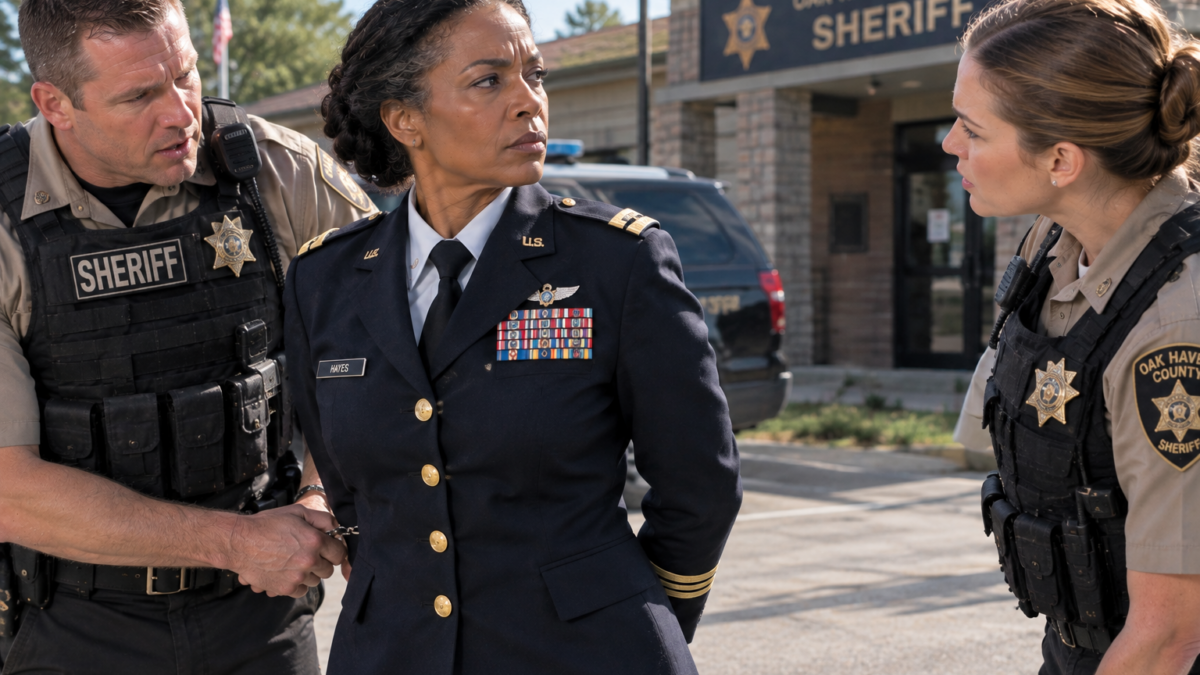
**CHAPTER 1 — THE RED PHONE**
The floor beneath the Oak Haven Sheriff’s Department began to tremble.
At first, Sheriff Boyd Cleary thought it was construction equipment moving along the highway.
Then Deputy Toby Miller looked through the booking-room window.
His face went pale.
“Sheriff…”
Boyd turned.
Outside, dust was rising across the back parking lot.
Two matte-black military helicopters descended beyond the county impound fence, their rotors beating the afternoon air hard enough to shake the glass in its frame.
Loose paper flew from the dispatcher’s desk.
A plastic evidence bag slid across the counter.
And in the middle of the noise—
the red emergency telephone rang again.
Boyd Cleary stared at it.
He had spent fourteen years as sheriff.
Before that, nine years as a deputy.
The phone had never rung.
Not once.
Now it had rung twice in less than five minutes.
Sarah Hayes stood beside the booking desk with one wrist still attached to a steel restraint ring.
Calm.
Perfectly still.
Almost frighteningly still.
Boyd looked at her.
Then at the helicopters.
Then back.
“What the hell did you do?”
Sarah’s expression did not change.
“I made a phone call.”
—
The red telephone rang a third time.
Deputy Miller whispered:
“You should answer it.”
Boyd glared at him.
“I know how a telephone works.”
He snatched up the receiver.
“Sheriff Cleary.”
The voice on the other end was calm.
Male.
Older.
Controlled.
“Sheriff Cleary, this is Major General Thomas Reed, United States Army.”
Boyd’s eyes flicked toward Sarah.
Nobody else spoke.
Reed continued.
“I am calling regarding Brigadier General Sarah Hayes.”
Boyd swallowed.
“She is being held in connection with a lawful arrest.”
There was a pause.
Then:
“What charges?”
Boyd looked toward the booking form.
Resisting arrest.
Disorderly conduct.
Failure to comply.
Suddenly all three sounded strangely thin.
“She became uncooperative during a traffic stop.”
Sarah’s eyes remained on him.
Reed answered:
“That is not what I asked.”
Boyd’s face reddened.
“I don’t have to discuss an active criminal case with the military.”
“You are correct.”
That response threw Boyd off.
Reed continued.
“The United States Army is not instructing you to dismiss charges.”
Nothing.
“We are notifying you that General Hayes was carrying a controlled federal communications device connected to her official duties.”
Boyd looked toward the plastic evidence tray.
The black device sat exactly where he had thrown it.
Reed continued.
“You will not attempt to access it.”
“I didn’t.”
“Good.”
Nothing.
“A Defense Department security team is being dispatched to document the device’s custody and verify whether its integrity has been compromised.”
Boyd looked out the window.
“At least part of that team appears to be here already.”
—
That was the first thing Boyd had misunderstood.
The helicopters had not come to storm his jail.
No soldiers were rushing toward the building with weapons drawn.
No general had ordered a local sheriff arrested.
The aircraft had already been supporting a regional military movement exercise less than fifty miles away.
Once Sarah failed to make a scheduled secure check-in and reported that a controlled communications device had been confiscated, one aircraft was diverted to transport security personnel.
The second carried a liaison team already operating in the region.
Still dramatic.
Still intimidating.
But not a military invasion.
Procedure.
That mattered.
—
Boyd tried to recover his confidence.
“So what? She gets special treatment because she’s important?”
Sarah finally spoke.
“No.”
He turned toward her.
She continued:
“My rank has nothing to do with whether you had cause to arrest me.”
Boyd’s jaw tightened.
“Don’t start.”
“The device is why the Defense Department responded quickly.”
Nothing.
“The legality of what you did is a different question.”
—
Toby looked toward her.
There was something in Sarah’s tone that made him understand she had already separated those two issues in her head.
Sensitive federal property.
One issue.
Her detention.
Another.
The sheriff wanted them combined.
That way he could tell himself everything happening now was merely powerful people protecting one of their own.
Sarah was not going to let him.
—
A knock sounded against the front entrance.
Then another.
The dispatcher opened the reinforced door.
Three people entered.
A woman in civilian clothes.
A uniformed Army colonel.
And a man wearing a state public-safety credential.
The woman stepped forward first.
“Sheriff Cleary?”
Boyd crossed his arms.
“Yes.”
“Special Agent Monica Reeves, Defense Criminal Investigative Service liaison.”
She displayed identification.
“This is Colonel Daniel Mercer from Army Protective Services coordination, and Investigator Alan Pierce from the state Office of Professional Standards.”
Boyd stared at Pierce.
He knew that name.
Every sheriff in the state did.
Professional Standards investigated officer misconduct complaints involving local agencies when state jurisdiction applied.
—
“What is he doing here?”
Pierce answered:
“Your dispatch center notified state communications that an interagency incident had occurred.”
“I didn’t request an investigation.”
“You didn’t need to.”
Nothing.
“I’m here to preserve records.”
—
Boyd laughed.
“For what?”
Pierce looked toward Sarah.
Then at the handcuff attached to the steel ring.
“For whatever happened before we got here.”
—
Sarah did not smile.
That was important.
She did not need a theatrical victory.
She needed the record preserved.
—
Monica Reeves approached the evidence tray.
“General Hayes, is that your issued device?”
“Yes.”
“Did Sheriff’s Department personnel attempt access?”
“Sheriff Cleary handled it and pressed the biometric surface at least once.”
Boyd snapped:
“I picked up a piece of property during booking.”
Monica looked at him.
“That may be entirely appropriate.”
He stopped.
She continued.
“That’s why I’m documenting it.”
—
Nobody accused him of espionage.
Nobody threatened him.
That almost made it worse.
Boyd understood anger.
He knew how to push against accusation.
Professional neutrality gave him nothing to fight.
—
Monica photographed the device where it sat.
Documented the seal.
Checked the integrity indicator.
Green.
No breach.
Then placed it into a government transport pouch.
Chain of custody signed.
Simple.
—
Pierce turned toward Boyd.
“I need the dash-camera recording from your cruiser.”
Boyd’s expression shifted.
“My camera wasn’t recording.”
Pierce looked up.
“Why?”
“Equipment issue.”
“Body camera?”
“Same.”
Toby lowered his eyes.
Sarah saw it.
Pierce did too.
—
“Deputy Miller.”
Toby looked up.
“Yes, sir?”
“Did Sheriff Cleary report an equipment malfunction before the stop?”
Toby glanced toward Boyd.
Boyd’s face hardened.
Toby hesitated.
“No, sir.”
—
Silence.
—
Boyd stepped toward him.
“Toby.”
Pierce moved slightly between them.
“Sheriff.”
Nothing.
“He answered my question.”
—
Boyd pointed toward Sarah.
“This whole circus is because she knows people.”
Sarah shook her head.
“No.”
Then:
“The helicopters are because I was carrying equipment your department cannot lawfully access.”
Nothing.
“The investigator is here because your own records now matter.”
—
Boyd stared at her.
“You think I’m afraid of my records?”
Sarah looked toward Toby.
The deputy’s face answered before his mouth ever could.
—
Pierce noticed.
“What is it?”
Toby said nothing.
Boyd snapped:
“Nothing.”
Pierce looked directly at Toby.
“Deputy?”
—
Toby swallowed.
“I think the sheriff should let General Hayes go.”
Boyd’s eyes widened.
“What?”
“There’s no arrest affidavit.”
“I’m writing it.”
“No citation either.”
“I said I’m writing it.”
“You said she crossed the yellow line.”
“She did.”
Toby looked toward the desk.
“The dispatch log says you called the stop as ‘DC rental, one female.’”
Nothing.
“You never reported a lane violation.”
—
Boyd’s face changed.
Sarah said nothing.
—
Toby continued because stopping now would be worse than continuing.
“You brought her in for resisting.”
“Yes.”
“What did she resist?”
Boyd stepped toward him.
“She refused lawful commands.”
“She got out.”
Nothing.
“She turned around.”
Nothing.
“She let you cuff her.”
—
Boyd shouted:
“You weren’t even there!”
Toby froze.
Pierce’s eyes sharpened.
“Exactly.”
—
Sarah understood before Boyd did.
If Toby had not witnessed the roadside encounter, he could not know whether Sarah resisted.
But neither could he independently support Boyd’s report.
Meaning the missing camera footage suddenly mattered much more.
—
Pierce asked Sarah:
“General Hayes, are you willing to provide a formal statement?”
“Yes.”
“Today?”
“Yes.”
“Before leaving?”
Sarah looked at the clock.
Her flight was gone.
Her schedule destroyed.
But something more important had appeared.
“Yes.”
—
Boyd laughed bitterly.
“So she sits here giving statements while I’m treated like a criminal?”
Pierce replied:
“You are not under arrest.”
“I’m the sheriff.”
“I’m aware.”
—
Then:
“And that does not make your report self-proving.”
—
At 4:18 PM, Sarah Hayes walked out of the Oak Haven Sheriff’s Department.
No charges had been filed.
No citation issued.
The federal security team transported her not because the Pentagon had “rescued” her from local law, but because her scheduled travel had been compromised and the secure device had to be returned through proper channels.
—
Toby watched from inside.
Boyd stood beside him.
Furious.
Humiliated.
And far more dangerous now than he had been when Sarah arrived.
—
“You embarrassed me.”
Toby looked at him.
“I answered questions.”
“You sided with her.”
“I sided with what I saw.”
Boyd stepped close.
“You didn’t see the stop.”
“No.”
Nothing.
“But I saw booking.”
—
Boyd stared.
Then lowered his voice.
“You’re young.”
Toby knew this speech.
He had heard versions of it for years.
“You’ve got a career here.”
Nothing.
“Don’t throw that away because some woman from Washington knows how to make people jump.”
—
Toby looked toward the empty evidence tray.
Then toward the camera in the booking room.
One camera Boyd had apparently forgotten about.
—
“Sheriff.”
“What?”
“You know that camera records audio, right?”
Boyd’s face changed.
—
The booking-room camera had captured everything.
Sarah identifying the device.
Boyd mocking her.
Sarah requesting her call.
Boyd asking whether she was “calling her mama.”
Sarah identifying herself to the National Military Command Center.
Boyd’s reaction.
His statements after the Pentagon called.
All of it.
—
And something else.
Twenty minutes before Sarah made the call—
Boyd had walked into his office with Toby.
The booking-room microphone did not capture the full conversation.
But the office security system did.
Installed after a burglary two years earlier.
Boyd had forgotten that too.
—
Pierce obtained preservation authority before leaving.
By midnight, the recording was secured.
At 9:14 the next morning, investigators listened.
Boyd’s voice came through clearly.
**She didn’t do anything serious.**
Toby:
**Then why book her?**
Boyd:
**Because people like that need to learn where they are.**
Toby:
**What people?**
A pause.
Then Boyd laughed.
**The ones who think Washington means something out here.**
—
That alone was troubling.
Then came the next sentence.
**Write resisting. I’ll make the rest fit later.**
—
Toby stopped breathing when investigators played it for him.
He had forgotten the exact words.
Sarah had never heard them.
Not until Pierce called her two days later.
—
Sarah sat in a secure conference room in Washington.
“Say that again.”
Pierce did.
Then added:
“That isn’t all.”
She closed her eyes.
“What else?”
—
“We started checking prior complaints.”
Sarah went still.
“How many?”
“Against Cleary?”
“Yes.”
Pierce hesitated.
“Forty-three that we can confirm.”
—
Sarah opened her eyes.
“Forty-three?”
“Seven years.”
—
“What kind?”
Pierce answered:
“Traffic stops.”
Nothing.
“Search disputes.”
Nothing.
“Disorderly-conduct arrests.”
Nothing.
“And a phrase that appears repeatedly.”
—
Sarah already knew.
“What phrase?”
Pierce said:
“Attitude.”
**END OF CHAPTER 1**
**CHAPTER 2 — THE PEOPLE WHO NEVER GOT A PENTAGON CALL**
The first person Sarah asked to meet was not another general.
Not the governor.
Not a federal prosecutor.
It was a forty-six-year-old electrician named **Marcus Dean**.
His complaint against Boyd Cleary was eighteen months old.
Sarah read it three times.
—
Stopped on Interstate 89.
Alleged lane drift.
Asked to consent to a vehicle search.
Refused.
Boyd described him as “argumentative.”
Marcus was arrested for obstruction.
Released the next morning.
Charges dismissed.
Complaint filed.
Complaint denied.
Case closed.
—
No Pentagon phone call.
No helicopters.
No senior officials asking why he was inside a cell.
Just one night gone.
A towing bill.
Missed work.
And a complaint stamped:
**UNFOUNDED.**
—
Marcus agreed to meet Sarah only after Pierce told him she had specifically requested it.
They sat inside a state government conference room.
Marcus looked at her uniform.
Sarah had come directly from work.
Three stars of responsibility might have felt more comfortable than civilian clothes that day.
Marcus looked at the ribbons.
Then laughed without humor.
“So that’s what it takes.”
Sarah knew what he meant.
“Yes.”
He looked surprised.
“You’re admitting it?”
“I am admitting my case received attention quickly because of my position and the secure equipment.”
Marcus leaned back.
“Mine didn’t.”
“No.”
—
He studied her.
Most powerful people would have tried to soften that.
Sarah didn’t.
—
“Then why are we talking?”
“Because my case does not prove yours.”
Nothing.
“But it caused investigators to find yours.”
—
Marcus stared.
Sarah continued.
“I want to understand what happened.”
—
He told her.
The stop.
Boyd’s questions.
Where are you going?
Why are you carrying cash?
Why don’t you want me looking in the trunk?
If there’s nothing illegal, what are you worried about?
—
Marcus said:
“I told him no.”
“To the search?”
“Yes.”
“What happened?”
“He smiled.”
—
Sarah knew the smile.
—
Marcus continued.
“He said refusing made me suspicious.”
Nothing.
“I told him refusing a search was not a crime.”
Nothing.
“And then he said I had an attitude.”
—
Sarah’s jaw tightened.
Same word.
—
“He ordered me out.”
Nothing.
“I asked why.”
Nothing.
“He said now I was obstructing.”
—
Marcus laughed bitterly.
“You know the rest.”
Sarah did.
—
The state review eventually examined fifty-eight cases.
Not every complaint proved misconduct.
Some drivers had genuinely resisted.
Some lied.
Several videos supported Boyd’s account.
Two involved dangerous pursuits.
One involved a driver who attempted to strike a deputy with a vehicle.
Those cases stayed exactly where they belonged.
—
But nineteen incidents raised serious discrepancies.
—
In six, body cameras were not activated.
In four, footage began only after the driver was already handcuffed.
In seven, reports described aggressive physical movements not clearly visible on video.
In eleven, Boyd escalated after a driver questioned the legal basis for a search or detention.
—
Race appeared too.
Of the nineteen strongest disputed cases, thirteen involved Black drivers.
Three involved Latino drivers.
Three involved white drivers.
That did not automatically prove racial motivation.
But investigators could not ignore it.
—
Sarah did not.
She also refused to claim more than evidence supported.
When a reporter asked:
“Was Boyd Cleary targeting Black motorists?”
Sarah replied:
“There is evidence of a serious racial disparity in the reviewed stops.”
Nothing.
“There is also evidence that Sheriff Cleary repeatedly treated verbal disagreement as a reason to escalate.”
Nothing.
“Investigators should determine how those facts interact.”
—
The reporter tried again.
“Do you think he is racist?”
Sarah looked at him.
“I think describing documented conduct is more useful than asking me to diagnose another person’s mind.”
—
That answer pleased almost nobody.
Which usually meant it was precise.
—
The investigation found something else.
Complaints against Boyd were reviewed internally.
By Boyd.
Or by supervisors who reported directly to him.
—
One clerk described the process.
A complaint arrived.
Boyd read it.
Called the deputy.
Sometimes called the complainant.
Then marked it:
Sustained.
Not sustained.
Unfounded.
Closed.
—
In a department with fourteen sworn officers, people accepted that as efficiency.
Nobody asked what happened when the complaint was against the sheriff himself.
—
Then investigators found the storage boxes.
Three cardboard banker boxes behind retired radio equipment.
Copies of complaint forms.
Old notes.
Reports.
Some were missing from the official digital system.
—
Toby knew about them.
He had started copying questionable files two years earlier.
Not because he planned to become a whistleblower.
Because he thought he was losing his mind.
—
“When did you first notice?”
Pierce asked him.
Toby looked down.
“A woman from Baltimore.”
Name:
**Dr. Evelyn Carter.**
Black.
Fifty-eight.
University professor.
—
Boyd stopped her for an obstructed plate.
Her plate was visible on dash footage.
He requested insurance.
She provided it digitally.
Then he asked where she worked.
She asked why it mattered.
—
According to Boyd’s report:
**Subject became hostile and repeatedly challenged lawful authority.**
According to the audio:
Evelyn said:
**Sheriff, I am asking why my employment is relevant to my license plate.**
Boyd answered:
**People who think they’re educated sometimes forget how to cooperate.**
—
No arrest.
Just a citation later dismissed.
Evelyn filed a complaint.
Nothing happened.
—
Toby saved it.
Then another.
And another.
—
Sarah asked Toby why he never reported Boyd.
They met after his attorney approved the conversation.
Toby stared at his hands.
“Because he had been good to me.”
Sarah waited.
“He got me this job.”
Nothing.
“When my mother had surgery, he covered two shifts.”
Nothing.
“He helped my brother after a wreck.”
—
Toby looked up.
“How do you report someone who has done good things?”
Sarah answered:
“By reporting what he did.”
—
Toby laughed sadly.
“That simple?”
“No.”
Nothing.
“But that clear.”
—
Boyd had not been evil every day.
That became important in Oak Haven.
Some residents defended him with stories that were true.
He found a missing child during a winter storm.
Helped flood victims.
Paid for groceries for an elderly couple.
Visited wounded deputies in hospitals.
—
Other residents told different truths.
Traffic stops.
Humiliation.
Searches.
Threats.
Complaints ignored.
—
The town wanted one story.
Good sheriff.
Bad sheriff.
Sarah refused both.
—
“A person can perform generous acts and still abuse authority.”
That line later appeared in newspapers.
She wished it hadn’t.
It sounded more profound than it was.
It was basic arithmetic.
—
Then the state found Boyd’s personal stop notebook.
Monthly numbers.
Ticket counts.
Warnings.
Searches.
Arrests.
—
One line stood out.
**89 corridor — outsiders easiest.**
His attorney said “easiest” referred to traffic enforcement because outsiders were less familiar with the speed transition.
Possible.
Then another line appeared two pages later.
**Complaints mostly travelers. Won’t come back.**
Harder.
—
And another.
**DC / MD plates usually push back.**
—
Sarah’s rental had Washington plates.
—
Then came the strongest evidence.
Not racial.
Not statistical.
Procedural.
Boyd’s dash-camera system was not broken during Sarah’s stop.
The device had been manually placed into privacy mode twelve minutes before he pulled her over.
—
Why?
Boyd said he had been making a personal telephone call.
Possible.
Except he never turned it back on.
And maintenance logs showed the same pattern in five previous disputed stops.
—
Manual deactivation.
Stop.
Complaint.
No video.
—
Investigators asked:
“Did you intentionally disable recording before encounters you expected might become confrontational?”
Boyd’s answer:
“No.”
“Then why does it happen repeatedly?”
“I don’t know.”
—
That answer worked less well the sixth time.
—
Toby’s copied records provided another lead.
A retired dispatcher named **Linda Mercer**.
She had worked with Boyd for twelve years.
When investigators contacted her, she initially refused to speak.
Then Boyd publicly called Toby a thief.
Linda changed her mind.
—
“He always did that.”
Pierce asked:
“Did what?”
“Made it about loyalty.”
—
Linda described calls where Boyd asked dispatchers to adjust incident descriptions.
Nothing dramatic.
Not inventing shootings.
Small wording.
—
**Uncooperative** instead of **questioning**.
**Refused command** instead of **requested clarification**.
**Aggressive demeanor** instead of **raised voice**.
—
One word at a time.
—
“Why?”
Linda said:
“Because paperwork becomes what people remember.”
—
Sarah wrote that sentence down.
—
Then Linda described a stop from four years earlier.
Black family.
Virginia plates.
Father, mother, teenage daughter.
Boyd claimed the father had been verbally aggressive.
The father filed a complaint.
A diner employee witnessed the encounter and offered video from an exterior security camera.
—
Boyd never collected it.
Why?
Linda remembered him saying:
**I don’t need a camera to tell me what happened to me.**
—
That sentence became the center of the case.
Not legally.
Psychologically.
—
Boyd trusted his perception so completely that contradictory evidence became unnecessary.
Then undesirable.
—
The state attorney general opened a civil-pattern investigation.
Federal civil-rights attorneys reviewed evidence separately.
Different authorities.
Different standards.
Nobody “sent the military after the sheriff.”
Sarah repeatedly corrected that misconception.
—
The Pentagon had finished its role almost immediately.
Secure device recovered.
Security incident documented.
Sarah’s travel rescheduled.
Everything after that came from state and civilian legal processes.
—
But the public loved the helicopters.
Of course they did.
Two black aircraft descending into dust looked like justice.
Paper preservation orders did not.
—
Sarah hated that.
Because the helicopters solved almost nothing.
Toby’s records did.
Dispatch audio did.
Body-camera metadata did.
Complaint files did.
Witnesses did.
—
Then came the county oversight hearing.
Boyd attended in uniform.
He had been temporarily removed from traffic enforcement but remained sheriff pending legal process.
Residents packed the room.
Some applauded him.
Others held signs.
Sarah wore civilian clothes.
No visible rank.
—
The commission chair asked Boyd:
“Why did you arrest General Hayes?”
Boyd answered:
“Because she refused to respect lawful authority.”
—
Sarah’s eyes closed briefly.
Still.
After everything.
Still.
—
The chair asked:
“What command did she refuse?”
Boyd said:
“She challenged the stop.”
“That isn’t a command.”
“She argued.”
“What did she refuse?”
Boyd’s face reddened.
—
His attorney whispered.
Boyd ignored him.
“She had an attitude from the beginning.”
The room changed.
—
Sarah looked toward Marcus Dean.
He looked back.
Same word.
—
The chair called Sarah.
She approached the microphone.
“Ms. Hayes, do you believe your rank influenced Sheriff Cleary’s decision to release you?”
“Yes.”
Boyd smiled.
The chair asked:
“How?”
Sarah replied:
“My rank caused outside institutions to pay immediate attention.”
Nothing.
“It did not change whether the original arrest was lawful.”
—
“Do you believe an ordinary person would have been released as quickly?”
Sarah looked toward Marcus.
Then Evelyn Carter.
Then Toby.
“I don’t know.”
Nothing.
“And that uncertainty is the most important problem in this room.”
—
Boyd shook his head.
“This is political theater.”
Sarah looked at him.
“No.”
Then:
“This is what happens when records survive.”
—
Pierce played the booking-office recording.
Boyd’s voice:
**She didn’t do anything serious.**
Then:
**Write resisting. I’ll make the rest fit later.**
No one moved.
—
Boyd stared at the table.
His attorney’s face tightened.
—
Then Pierce played another recording.
Recovered from an older patrol unit.
Marcus Dean’s stop.
Boyd’s voice:
**You people come through here thinking you know every law.**
Marcus:
**I’m asking why you want to search my truck.**
Boyd:
**Because I asked.**
Marcus:
**That’s not consent.**
Long pause.
Then Boyd:
**There’s that attitude.**
—
Marcus lowered his head.
He had not heard the recording since that night.
—
The commission room erupted.
The chair pounded the gavel.
Sarah stayed still.
—
Boyd looked at her.
For the first time, there was no arrogance.
Only accusation.
“You did this.”
Sarah shook her head.
“No.”
Nothing.
“You did.”
—
He stared.
—
Then Toby Miller stepped to the second microphone.
His hands were shaking.
But his voice was not.
“I helped him.”
The room went silent again.
Boyd turned.
Toby continued.
“Not with General Hayes.”
Nothing.
“Before.”
—
Sarah looked at him.
This was new.
—
Toby’s eyes filled.
“I changed language in two reports because he told me to.”
Boyd stood.
His attorney grabbed him.
—
Toby continued.
“I told myself I was correcting wording.”
Nothing.
“I wasn’t.”
—
Which reports?
One belonged to Dr. Evelyn Carter.
The other—
Marcus Dean.
—
Marcus stared at him.
Toby could barely look back.
—
“I changed ‘declined consent’ to ‘refused instructions.’”
Nothing.
“And I changed ‘questioned detention’ to ‘became argumentative.’”
—
Toby’s voice broke.
“I’m sorry.”
—
Marcus did not forgive him.
Not then.
Maybe never.
But the truth entered the record.
That was separate.
—
Boyd looked around the room.
His authority was not collapsing because a general outranked him.
It was collapsing because people who had helped maintain his version of events had stopped doing it.
**END OF CHAPTER 2**
**CHAPTER 3 — THE HELICOPTERS WERE THE LEAST IMPORTANT PART**
Boyd Cleary resigned six weeks later.
Not dramatically.
No handcuffs outside the courthouse.
No helicopter waiting.
A two-page letter submitted through counsel.
He said the investigation had made effective leadership impossible.
He denied racial bias.
Denied knowingly making unlawful arrests.
Admitted “administrative mistakes.”
—
His resignation did not end the investigations.
That surprised some people in Oak Haven.
It surprised Boyd most.
—
The state pursued charges tied to falsification of official records in several specific cases.
Not every questionable stop became a criminal count.
The evidentiary standards were different.
Some files were too old.
Some footage missing.
Some complaints impossible to corroborate.
—
Federal civil-rights investigators reviewed whether broader criminal statutes applied.
They did not charge every allegation people demanded online.
Again—
evidence.
Standards.
Specific conduct.
—
Boyd eventually faced trial on state record-related offenses.
Sarah testified.
So did Toby.
Linda Mercer.
Marcus Dean.
Several former motorists.
—
Boyd’s attorney had a strategy.
Power.
He portrayed Sarah as a Washington general who could not tolerate being challenged by a small-town sheriff.
The framing was clever.
Because privilege did matter.
Sarah had received immediate attention others had not.
Pretending otherwise would have weakened her.
—
On cross-examination, the attorney asked:
“You had the National Military Command Center contacted within minutes?”
“Yes.”
“Two military helicopters arrived?”
“Yes.”
“Senior officials contacted the department?”
“Yes.”
“Would Marcus Dean have received that response?”
“No.”
The courtroom murmured.
—
The attorney stepped closer.
“So this case exists because you are powerful.”
Sarah thought for a moment.
Then:
“This investigation began quickly because I had access to powerful institutions.”
Nothing.
“The recordings do not exist because I am powerful.”
Nothing.
“The altered reports do not exist because I am powerful.”
Nothing.
“The other complainants did not appear because I am powerful.”
—
She looked toward the jury.
“My position opened a door.”
Nothing.
“What was already behind it created this case.”
—
The attorney moved on.
—
Toby’s testimony was worse for Boyd.
And for Toby.
He admitted changing language.
Admitted remaining silent.
Admitted preserving copies without initially reporting them.
—
Boyd’s lawyer asked:
“You want this jury to believe you suddenly developed a conscience?”
Toby shook his head.
“No.”
“Then why testify?”
“Because I helped make people look less credible on paper than they were in real life.”
Nothing.
“And I can’t undo that by pretending I was only following orders.”
—
Marcus watched from the gallery.
Still angry.
But listening.
—
The jury convicted Boyd on several record-falsification counts.
Acquitted him on one.
Deadlocked on another.
Messy.
Human.
Real.
—
Sarah did not smile when the verdict was read.
Neither did Marcus.
—
Outside the courthouse, cameras surrounded her.
A reporter shouted:
“General Hayes, is this justice?”
Sarah stopped.
She hated questions like that.
Too large.
Too final.
—
“This is a verdict in specific criminal counts.”
Nothing.
“Justice is a bigger word.”
—
Another reporter:
“Do you forgive Sheriff Cleary?”
“That is not relevant to the case.”
—
Another:
“Was this racism?”
Sarah paused.
Then answered with the same precision she had used from the beginning.
“The investigations documented serious racial disparities, repeated complaints from Black motorists, improper escalation, record manipulation, and failures of independent oversight.”
Nothing.
“People can draw conclusions from documented facts.”
—
She left.
—
Oak Haven changed.
Slowly.
The new sheriff inherited a department full of people who were tired of being famous for the wrong reason.
Body-camera compliance became automatic audit data.
A sheriff could no longer personally close complaints against himself.
Traffic-stop reports required clear articulation of the original violation before unrelated investigative questioning expanded.
Consent searches were documented.
Complaint status could be tracked online.
—
No policy guaranteed good behavior.
But fewer decisions vanished into one person’s desk.
—
Toby resigned too.
That surprised Sarah.
He had cooperated.
Some people thought he should remain and reform the department.
Toby disagreed.
—
“I need to stop being the story here.”
He told Sarah during their final meeting.
“What will you do?”
“Start over.”
“Where?”
He smiled faintly.
“Somewhere they don’t know my name.”
—
Sarah understood the appeal.
—
Before leaving, Toby met Marcus Dean.
Privately.
Sarah was not there.
She heard about it afterward.
—
Toby apologized.
Marcus listened.
Then said:
“You want me to tell you you’re a good man?”
Toby answered:
“No.”
Good.
—
Marcus continued.
“You changed words that kept me from being believed.”
“I know.”
“You went home that night.”
“I know.”
“I spent mine in jail.”
“I know.”
—
Then Toby said:
“I don’t know how to make that even.”
Marcus replied:
“You can’t.”
Nothing.
“So stop trying to make yourself feel even.”
—
Toby carried that with him.
—
Dr. Evelyn Carter received a corrected complaint finding.
No dramatic settlement.
No front-page apology.
Just an official letter stating the prior review had been inadequate and that available evidence did not support the characterization of her as hostile or uncooperative.
—
She framed it.
Sarah asked why.
Evelyn laughed.
“Because for seven years their file called me a problem.”
Nothing.
“Now it doesn’t.”
—
Sometimes dignity is bureaucratic.
—
Marcus petitioned to correct records tied to his detention.
The process took months.
He complained constantly.
Sarah encouraged him to keep complaining.
—
One afternoon he called her.
“They fixed it.”
“What?”
“The incident record.”
Sarah smiled.
“How do you feel?”
“Annoyed it took this long.”
“Appropriate.”
—
Then:
“Thank you.”
Sarah paused.
“For what?”
“For getting arrested.”
She laughed.
“That was not intentional.”
—
Marcus became serious.
“You know what I mean.”
“Yes.”
—
Sarah’s military career continued.
Most days, Oak Haven became a strange story people elsewhere knew better than she wanted.
She returned to classified briefings.
Budgets.
Readiness reviews.
Calls at terrible hours.
—
The secure communications device that Boyd tossed into the evidence tray was inspected.
No compromise.
Returned to service.
Eventually replaced by a newer model.
Sarah almost asked to keep the old one.
She didn’t.
Government property.
—
The helicopters became famous.
Photos appeared everywhere.
People captioned them:
**SHERIFF MESSED WITH THE WRONG WOMAN.**
Sarah hated that phrase most.
Wrong woman.
As though there were a right woman to treat that way.
—
During a leadership speech years later, a young major asked her about Oak Haven.
“Ma’am, what went through your mind when the helicopters arrived?”
Sarah smiled.
“Mostly that somebody was going to complain about the fuel bill.”
The room laughed.
—
Then she became serious.
“The helicopters are the least important part of that story.”
The major frowned.
“They looked pretty important.”
“They made good video.”
—
Sarah walked toward the edge of the stage.
“The important part happened before anyone knew my rank.”
Nothing.
“A sheriff believed disagreement was disobedience.”
Nothing.
“He believed his first interpretation mattered more than verification.”
Nothing.
“And a department had built processes that allowed that interpretation to become the official record.”
—
She paused.
“The aircraft did not expose that.”
Nothing.
“The records did.”
—
Then:
“And the people who had complained before me.”
—
Her father lived long enough to watch the reforms in Oak Haven.
Colonel David Hayes, retired.
The man who taught her to keep both hands visible during a stop.
One evening they sat on his porch.
He looked at her.
“You still drive through that town?”
“Sometimes.”
“You nervous?”
Sarah thought.
“Yes.”
He nodded.
Good.
Not because he wanted her afraid.
Because honest fear is easier to carry than pretending it disappeared.
—
He asked:
“What would have happened if you weren’t a general?”
Sarah looked toward the sunset.
“I don’t know.”
“That bother you?”
“Yes.”
—
Her father nodded.
“That’s the whole thing, isn’t it?”
Sarah looked at him.
“Yes.”
—
Because perhaps Boyd would have released her later.
Perhaps the charges would have been dismissed the next morning.
Perhaps she would have paid a lawyer.
Perhaps her complaint would have entered a cardboard box.
Perhaps nothing more would have happened.
—
Nobody could know.
And that was precisely why the case mattered.
—
Years later, Sarah drove Interstate 89 again.
Same heat.
Same speed-limit drop.
Sixty-five.
Forty-five.
She slowed to forty-four.
Old habit.
—
The faded billboard was gone.
So was the place Boyd used to park.
A newer patrol vehicle sat farther down the road.
Sarah’s hands tightened on the steering wheel.
Then relaxed.
—
She passed the sheriff’s department.
No helicopters.
No reporters.
No dust cloud.
Just a county building beneath an ordinary afternoon sky.
—
Outside stood a new sign:
**PUBLIC COMPLAINTS ARE REVIEWED INDEPENDENTLY.**
Below it:
Phone number.
Website.
Case-tracking instructions.
—
Sarah slowed just enough to read it.
Then continued.
—
The people online remembered the red phone.
The helicopters.
The general.
The arrogant sheriff.
Those were the cinematic parts.
—
Sarah remembered something smaller.
Boyd holding her license.
Her real name printed directly in front of him.
Her car sitting legally inside the lane.
Her hands visible.
Her voice calm.
Every opportunity to stop.
—
He had not needed to know she was a brigadier general.
He had needed to know only one thing:
His certainty was not evidence.
—
And that was why the most important sentence in the entire story was never spoken by a Pentagon official.
It was the question Sarah asked on the roadside before the cuffs closed around her wrists.
**“Are you issuing a citation, or are you detaining me?”**
Boyd could have answered it.
Instead, he decided the question itself was an attitude problem.
Everything that followed began there.
### **END OF CHAPTER 3**
You Might Also Enjoy

Beyond Espresso: The New Wave of Coffee Innovation

The Renaissance of Physical Libraries in the Digital Age
